

A 96% score on your test set doesn't guarantee production success. This article explains why static evaluation datasets built from known scenarios and scripted queries can't catch the messy realities of real users: incomplete sentences, tool errors, shifting policies, and "agent decay" as prompts and systems change over time. It makes the case for dynamic, production-grade evaluation that tests how agents handle uncertainty, recover from errors, and ask clarifying questions instead of guessing, and shows how continuous monitoring of real interactions closes the gap that black-box, pre-deployment testing leaves open.
AI Agent Evaluation: Why Static Test Sets Are Not Enough for Production
By VoxMith | Updated August 2026
Consider an AI agent that scores 96% on your test data.
It knows what the user asks for, chooses the right tool, performs the expected flow and gives the right output. Everything passes the approval by the team and the agent goes to production, and the initial results seem very promising.
Some time passes.
An API gives back partial data. Clients ask something in another way. A new product policy makes new questions appear. A response from a tool takes too much time. The agent fails to interpret an interruption, says something again or does something wrong.
There was nothing necessarily wrong with the initial test data. The thing is that the test data is something static while production is something dynamic.
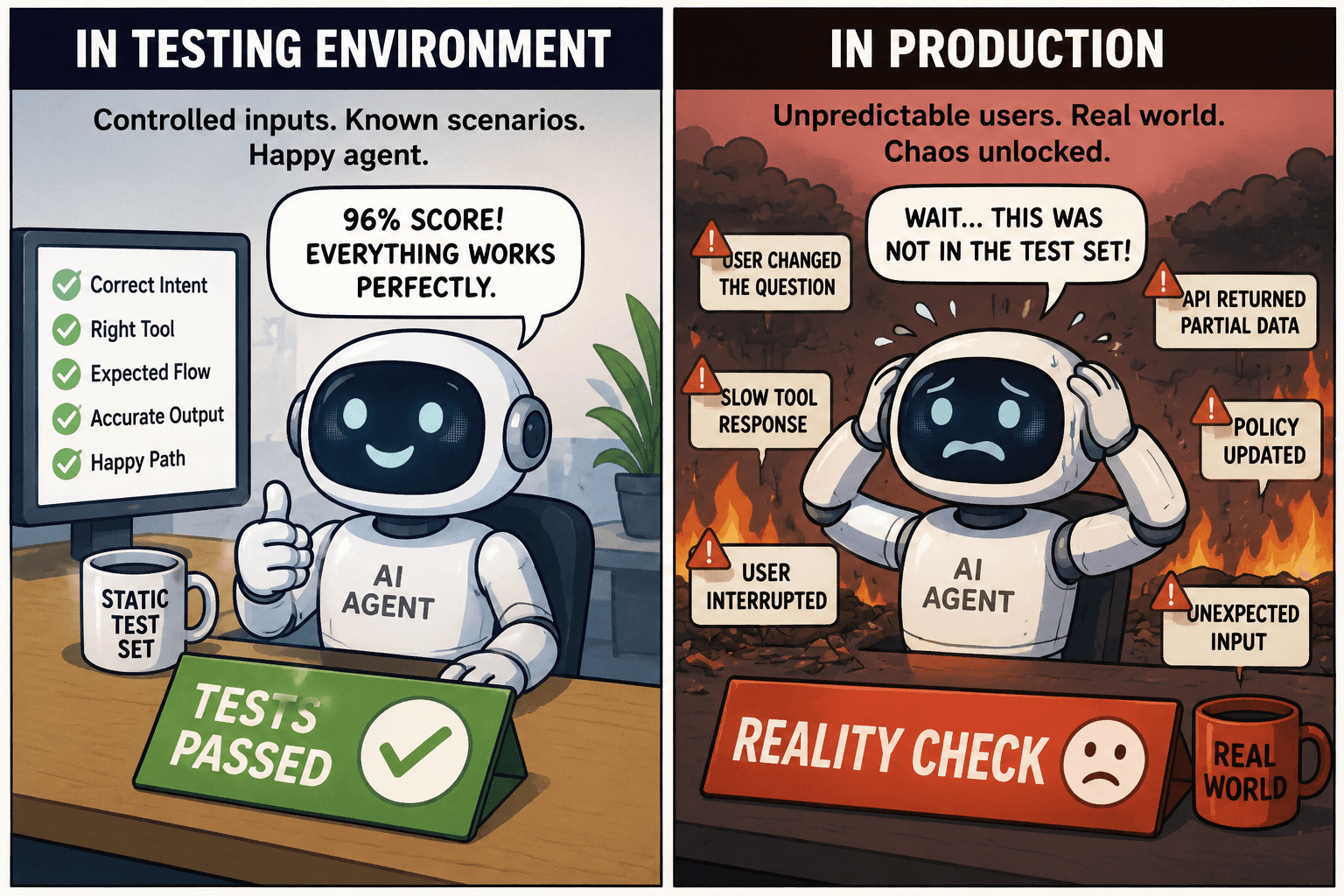
This is the crux of the problem in evaluating AI agents. Evaluating agents in static datasets may be useful for known cases, but they cannot guarantee that the agent will perform consistently in all possible situations. AI agents function through multi-turn dialogue, external utilities, evolving datasets, unpredictable users, and unreliable environments.
What Is AI Agent Evaluation?
Evaluating AI agents consists of determining whether AI agents function in their designated ways appropriately, safely, reliably, and efficiently.
An effective evaluation framework of AI agents must consider the complete path of execution and not just the final result or message.
Evaluation area | Key question |
Task success | Did the agent achieve the user’s real goal? |
Accuracy | Was the information correct and relevant? |
Tool use | Did the agent select and use the right tool? |
Reliability | Was it consistent through its variations? |
Safety | Was it safe, private and compliant with all policies? |
Recovery | Was its response appropriate during errors? |
Efficiency | Was it efficient enough and priced at the right rate to complete the process? |
User experience | Did the interaction feel clear, natural, and useful? |
Business impact | Did the agent improve the intended business outcome? |
In its investigation into agent evaluation in the real world, Amazon notes that current LLM agent evaluations take the approach that considers agents a black box, evaluating them on the basis of the output. This means that it becomes impossible to find out what went wrong when an agent failed.
The Limits of Static Evaluation Datasets
In static evaluation sets, the input, output, and metrics for evaluating success are all pre-specified. Static sets can be derived from business use cases, previous conversations, domain knowledge, or even generated out of thin air.
They test known situations
The testing scenarios will typically be those the team has seen before; they might involve regular user queries, familiar workflows, and typical corner cases.
But production users will not be doing scripted things
They will have incomplete sentences, uncommon words, accents, slang, emotive language, and poor instructions.
They do not capture agent decay
This is when agents become inefficient over time. The databases become modified. The prompts become different. The tools and systems are changed.
The environment changes and policies are introduced. Users and processes are different. An agent can no longer work well once deployed.
Production Intelligence: The Missing Layer
Production intelligence refers to using empirical interaction data for understanding the behavior of an agent post-deployment.
Not just transcripts but analysis of:
Requests and intent.
Agent response.
API calls and output.
Steps of information retrieval.
Memory update.
System latency.
Decision to escalate.
Corrective actions by the user.
User abandonment.
Outcomes of the business.
Production data gives an insight into how the user is really working as opposed to what the team assumes the user would be doing.
Why Dynamic Evaluation Is More Reliable
Dynamic evaluation adds varying inputs, environments, users, tools, and conditions to the testing process.
Rather than testing how an agent will respond to one particular problem, teams run tests by adding elements that create a branching conversation or alter the environment.
Dynamic evaluation might test any of the following conditions:
A user modifies the original query.
A tool throws an error.
Information supplied by a customer proves to be incomplete.
The caller interrupts the agent.
A policy changes partway through the process.
A slow response from an API.
The customer gets irritated.
A human handover becomes necessary.
The purpose isn’t to anticipate all problems. This would be impossible. The purpose is to check whether the agent understands when things become uncertain, recovers safely, asks clarifying questions, and avoids making unwarranted assumptions.
How VoxMith Supports Continuous AI Evaluation
VoxMith helps enterprises move beyond static AI agent evaluations by analyzing real production interactions.
Production Interaction Intelligence: VoxMith continuously captures and analyzes real production interactions after deployment, across any conversational interface. This gives teams a clear, ongoing understanding of how their AI agents actually behave with real users, rather than relying on assumptions from pre-deployment testing.
Production Failure Detection: VoxMith detects hallucinations, workflow failures, policy violations, tool failures, API failures, customer drop-offs, and escalations as they happen. This allows teams to catch failures before they impact customers.
Business Intelligence VoxMith extracts customer feedback, product opportunities, objections, FAQs, and revenue insights from production interactions. This turns everyday production conversations into usable product and GTM intelligence.
Root Cause Analysis: VoxMith determines exactly why production failures occurred tracing the issue across prompts, knowledge, workflows, tools, models, or integrations. This eliminates guesswork during debugging and points teams directly to the source of the problem.
Continuous Learning Loop VoxMith measures whether deployed changes actually improve production performance and detects regressions. This ensures every release measurably improves AI reliability, rather than assuming a fix worked
FAQs
Why does a 96% test score still fail in production?
Test sets only cover known scenarios. Production brings messy queries, tool errors, and policy changes the tests never saw.
What is "agent decay"?
Performance drops over time as prompts, tools, and policies shift after launch even with no new code.
Static vs. dynamic evaluation, what's the difference?
Static checks fixed inputs/outputs. Dynamic tests how the agent handles change: errors, interruptions, rephrased queries.
Why is "black box" evaluation a problem?
Judging only the final output hides why an agent failed, making debugging guesswork.
