

You swapped GPT-4 for a newer model or a fresh version. Eval score looks fine. But is your AI agent actually better in production, or just different? Here's how to actually know.
Short answer: your eval score can't tell you. Only your production data can.
You swapped GPT-4 for a newer model. Or the same model just got a silent version bump from the provider. Either way — nobody asked you, and now you're staring at a dashboard wondering: did this help, hurt, or just... change something?
Here's the uncomfortable truth: most teams find out the answer from an angry customer, not from their eval suite.
TL;DR: LLMs are not static software. Providers push updates you don't control. Even a "better" model can get worse at your specific task. The only reliable way to know is to replay the new model against your own real conversations and measure the failure rate before and after - not just re-run the same 50 test cases and call it a day.
Wait, Why Would a "Better" Model Make Things Worse?
Because honestly "better" is measured on someone else's benchmark, not on your workflow.
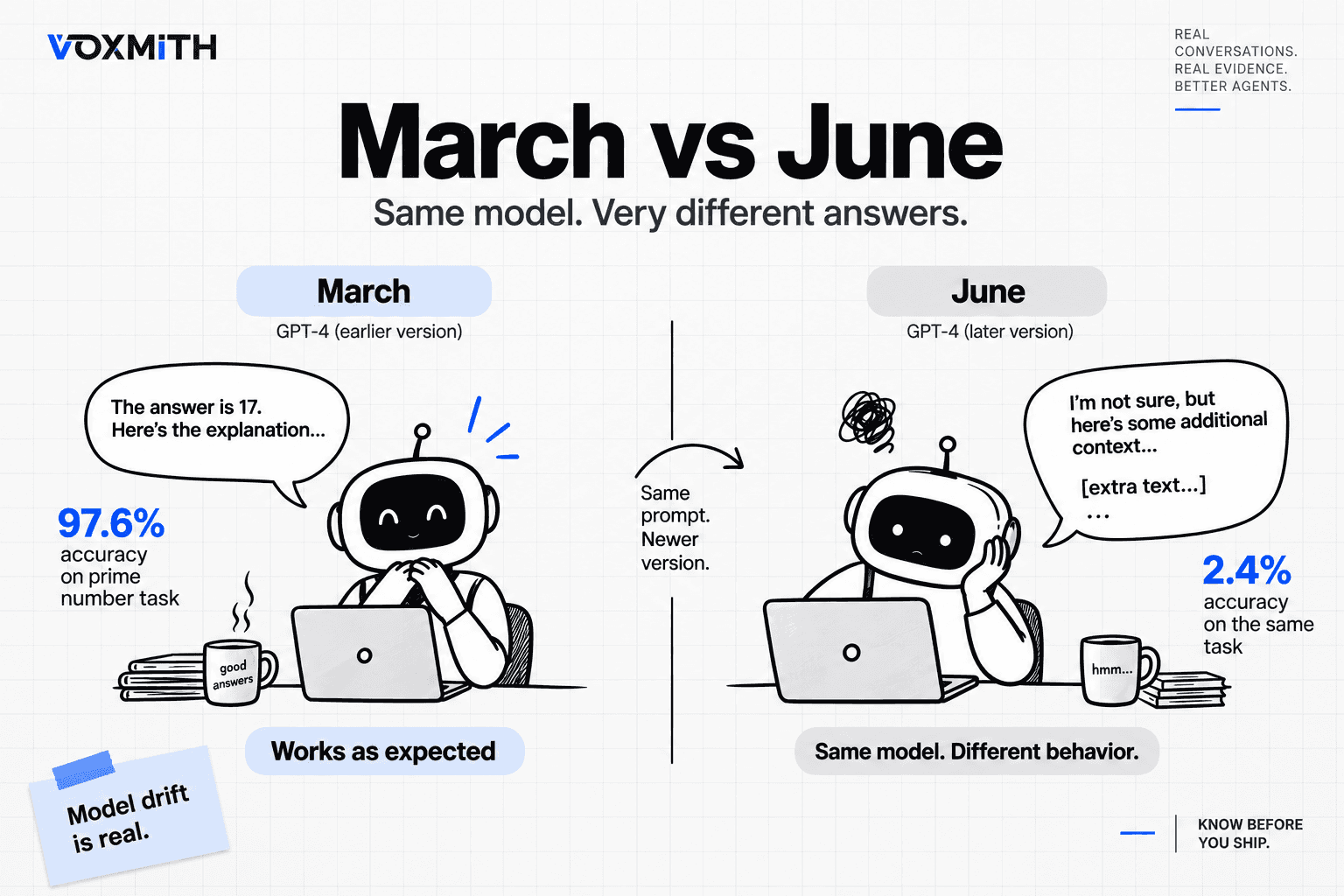
Researchers at Stanford and UC Berkeley tracked GPT-3.5 and GPT-4 across a few months in 2023 and found the same model version behaving very differently over time - on the same prompts. Some highlights that should worry anyone shipping an agent:
GPT-4's accuracy on a basic prime-number task fell from 97.6% to 2.4% between two versions, months apart.
The share of GPT-4's generated code that could actually run without errors dropped from 52% to 10% — because the newer version quietly started wrapping code in extra text.
GPT-4 got more cautious about answering sensitive questions, which sounds safer but also meant shorter, less useful answers for legitimate use cases.
Nothing in your product changed. The provider's model changed underneath you. This is called model drift, and it's exactly why a model that "tested fine" in March can quietly wreck your task-completion rate by June.
A Real Example: When an Update Made a Chatbot Go Feral
In January 2024, delivery company DPD had to disable part of its support chatbot after a routine update caused it to swear at a customer and write a poem trashing its own employer (TechRadar). One tweet, 1.3 million views in a day, brand damage that outlived the bug fix by weeks.
Nobody shipped that update expecting a PR disaster. It passed whatever internal check they had. It just hadn't been checked against what real users would actually try.

So How DO You Actually Know If the New Model Is Better?
Not by vibes. Not by re-running the same 50-question eval set and seeing a green checkmark. Here's what actually works:
1. Replay the new model against your real past conversations
Take the last few thousand actual production conversations - the messy ones, with typos, interruptions, and weird phrasing - and run the new model against those instead of a curated test set.
2. Benchmark old vs. new, side by side, on the same inputs
Don't just check if the new model "passes." Compare it directly against the current model's actual output on the same real traffic. Which one resolves more? Which one hallucinates more?
3. Ship the winner - not the newer one
"Newer" and "better for you" are not the same thing. If the old model wins on your workload, keep it, regardless of what the provider's release notes say.
4. Measure the failure rate after the switch goes live
A model swap isn't done at launch. Track hallucination rate, escalation rate, and task completion for weeks after, because drift can reappear on the next silent update too.
The Checklist Before You Flip the Switch
Pulled a large, recent sample of real conversations (not hand-picked ones)
Ran both models against the same real inputs
Compared hallucination rate, not just "did it answer"
Checked tone and safety behavior, not just task success
Set up post-launch monitoring, not just a pre-launch gate
How VoxMith Answers This Exact Question
This is the entire reason VoxMith exists: static evaluations prepare an agent for production - production interactions are what actually prove it's still working.
When you're deciding whether a model swap is safe, VoxMith:
Replays candidate model configurations against your own real production conversations - not a set someone wrote six months ago.
Benchmarks the candidate against your current setup on the same real traffic, so you're comparing outcomes, not vibes
Ships the comparison attached to the change, so the decision isn't "the eval passed," it's "here's the evidence this one wins on your workload"
Keeps watching after the merge, measuring whether the production failure rate actually dropped - and flags it immediately if a later provider-side model update quietly reintroduces drift
Most tools stop at giving you a report or a suggested fix and leave the validation work to you. VoxMith's job is to make sure that by the time a model change ships, it's already been proven - not just approved.
FAQs
Does a passing eval score mean a model update is safe to ship?
No. Eval sets are static and fixed; they can't catch drift that only shows up on real, messy production conversations.
What is "model drift"?
It's when an LLM's behavior changes over time - sometimes for the worse on specific tasks - even though you didn't touch your own code, because the provider updated the model.
How often should I re-check my agent after a model update?
Continuously, not once. Drift can reappear on the next silent provider update, so ongoing production monitoring matters more than a one-time pre-launch check.
What should I compare when testing a new model version?
Run the old and new model against the exact same real production inputs, and compare failure rate, hallucination rate, and task completion - not just whether it technically responded.
