

Your eval set says 96%. Your customers say something else. Here's why production conversations catch what static test sets are structurally built to miss.
Short answer: your eval set only tells you about the cases someone thought to write down. Production tells you about everyone else.
Your agent scores 96% on your eval set. Everyone claps. It ships.
Three weeks later, support tickets are up, a patient had to repeat their date of birth twice, and someone on the product team is asking why the "high-performing" agent keeps getting the same complaint. What happened?
Nothing happened to the eval set. It's still passing. That's exactly the problem.
TL;DR: Eval sets are a frozen snapshot of what your team imagined users would ask. Production is what users actually ask - messier, weirder, constantly shifting. You can have a 96% eval score and a badly broken agent at the same time, because those two numbers are measuring completely different things.
Why Can a 96% Score and a Broken Agent Both Be True?
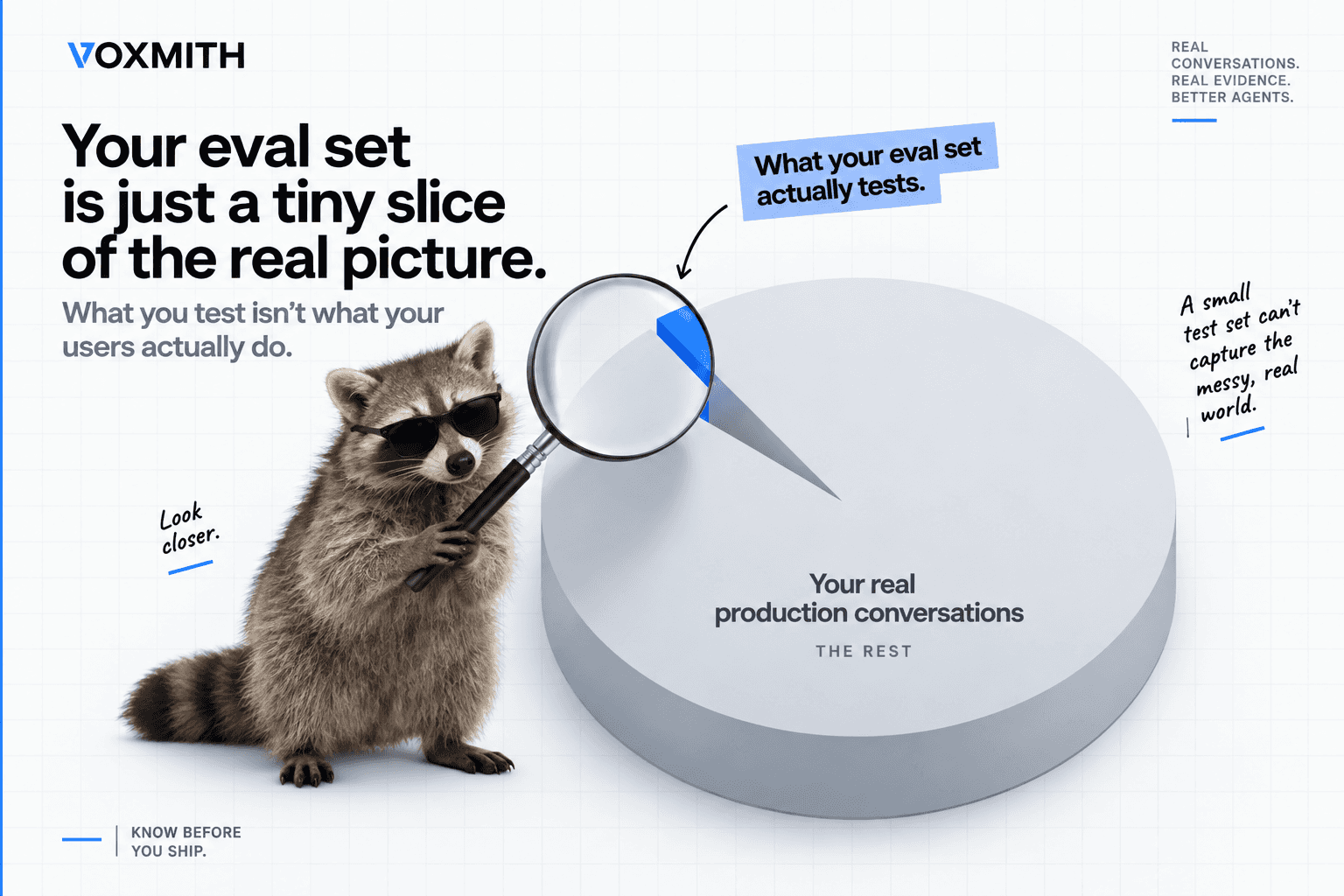
Because an eval set and your real user base are two different populations, and nobody is checking whether they still match.
One analysis put it plainly: if your eval set was 85% representative of production traffic when you built it, drift quietly erodes that every month - new use cases, retired ones, shifted phrasing.
Two quarters later, maybe only 55% of your eval still reflects what users actually send. Your "91% passing" score is now 91% accurate on just over half of reality, and a coin flip on the rest.
And the part that should really bother you: the untested half is usually the part that's growing. New features, new customer segments, new edge cases - that's where the eval set has zero coverage, and that's also where the volume is increasing.
Scenario: The "Successful" Call That Wasn't

Picture a healthcare scheduling agent. A patient calls, the agent routes them correctly, books the appointment. Dashboard says: completed.
Except the patient had to give their date of birth twice. Nobody explained the fasting requirement. They called back later just to ask if they needed to fast. On the ops dashboard, this shows up as one clean, successful call. On the patient's end, it was two calls and unnecessary friction.
Your eval set will never catch this, because nobody wrote a test case for "agent technically completes task but leaves the human confused." Production conversations catch it immediately, because the second call is the evidence.
Scenario: The Feature Nobody Tested Because Nobody Knew to Ask
A team ships a new pricing tier in Q3. Support volume about it spikes immediately. But the eval set was written at launch, back when users only asked about account setup and basic navigation.
Six months later, the model handles the new billing questions "adequately, not well" - and there's zero eval signal on it, because those questions simply didn't exist when the test cases were written. The aggregate score still looks great, because the majority of test cases - the old ones - still pass.
What Production Conversations Catch That a Static Set Structurally Can't
Phrasing your team never thought to write. An eval set of 50 hand-built cases can't capture how 10,000 real users will phrase the same intent.
Rare-but-costly failure clusters. A failure mode that hits 5% of traffic looks like 500 real conversations - but scatter that across a random 100-sample review and you'll see it maybe five times. Easy to write off as noise. It isn't.
The inputs no one predicted: unexpected phrasings, missing context, domain edge cases, and multi-step interactions that only appear once the agent is actually being used at scale.
Silent drift from a provider-side model update - same prompt, different answer, no code changes on your end at all.
The stakes of getting this wrong aren't small. MIT's State of AI in Business 2025 found that 95% of enterprise generative AI pilots deliver no measurable ROI, and a chunk of that gap is exactly this: teams measuring the wrong thing, confidently.
So What Should You Actually Do About It?
Stop treating your eval score as a finish line. It's a pre-launch gate, not a health metric.
Sample production traffic continuously, not once a quarter.
Cluster failures by pattern, not by single incident - one weird call is noise, a hundred identical weird calls is a fix waiting to happen.
Feed real failures back into your eval set so it stops being frozen and starts tracking your actual users.
How VoxMith Closes This Gap
VoxMith exists because of this exact blind spot. Instead of stopping at synthetic test cases, it continuously reads every real production conversation - not a sample, not a curated set - and turns it into:
Failure detection, catching hallucinations, broken workflows, policy violations, and drop-offs as they happen, before they pile up into a support-ticket spike
Root cause analysis that traces a failure back through prompts, tools, retrieval, or the model itself - instead of leaving you to guess why something broke
Pattern intelligence, so a failure that hits 5% of traffic doesn't get lost inside a random review sample - it gets surfaced, ranked, and prioritized
Candidate fixes benchmarked against your own replayed production traffic before they ship - so the pull request that lands already has evidence it beats the current setup, not just a passing eval
The result: your eval set becomes a pre-launch gate, and your production conversations become the ongoing, honest scoreboard - which is what a "96% and everyone's still frustrated" agent was always missing.
FAQs
Why can an AI agent pass its eval set and still fail in production?
Because eval sets are static snapshots of scenarios someone predicted, while production traffic constantly shifts - new phrasing, new features, new user segments the eval was never updated to include.
How much can eval coverage drift over time?
Analyses suggest an eval set that was ~85% representative at launch can fall to roughly half that within two quarters, as user behavior evolves and the test set stays frozen.
What's the difference between offline and online evaluation?
Offline evals run on a fixed, curated dataset before release. Online evals score real production traffic continuously, catching failure modes no pre-launch test suite could anticipate.
Is a high containment or completion rate proof the agent is working well?
Not on its own - a call can be marked "completed" while the customer had to repeat themselves, got no guidance, or called back for clarification, none of which shows up in a simple completion metric.
